




.svg)

EU Methane Regulation Compliance: Bridge North American MRV to EU Standards
Regulation (EU) 2024/1787 requires EU importers to prove — by 1 January 2027 — that every upstream supplier under contracts concluded or renewed after 4 August 2024 operates under MRV standards equivalent to the EU's. EarnDLT's QET-LNG is the compliance artifact that makes that proof transferable, machine-readable, and audit-ready at scale.
Book a Compliance Demo
Schedule 30 minutes with the EarnDLT team


The Regulatory Problem:
Two MRV Worlds,
One Compliance Deadline
MRV equivalence — a determination that a non-EU measurement, reporting, and verification regime is sufficiently comparable to EU requirements to satisfy import-facing obligations — is the central compliance test under the EU Methane Regulation for every LNG cargo shipped from the United States to Europe.
The problem:
North American upstream operators report under a fragmented ecosystem of recognized frameworks — OGMP 2.0, MiQ, NGSI, OGCI, OneFuture, ISO 14067, and others — each applying different reporting boundaries, emission source categorizations, and intensity calculation conventions. Midstream operators face a further patchwork. The EU requires a single, harmonized evidence standard. There is no direct interoperability between these systems by default.
The practical consequence is that EU importers currently face a choice between requiring all suppliers to adopt a common methodology (commercially unworkable), assembling bespoke per-supplier audit packages (expensive, non-scalable), or accepting the regulatory risk of arriving at the January 2027 deadline without a defensible evidence layer. EarnDLT® seamlessly connects the fragmented parts of the commodities industry, allowing for an unprecedented level of data utilization.
How EarnDLT Solves
MRV Equivalence
EarnDLT's QET-LNG is a measurement-standard agnostic environmental attribute token. It accepts upstream emissions data from any recognized North American MRV framework, captures the specific methodology as provenance metadata within the token's structure, and normalizes the output into an ISO 14064-3/14067-aligned, machine-readable artifact. The EU importer receives a single, standardized compliance artifact — regardless of which MRV framework the upstream supplier follows.
This design eliminates the need for importers to dictate supplier methodology or commission per-supplier re-verification. The token itself carries sufficient methodological transparency to satisfy Article 27's equivalence requirement.
Book a Compliance Demo
Schedule 30 minutes with the EarnDLT team
What's Required Under
Regulation (EU) 2024/1787
Article 27 of the EU Methane Regulation
establishes three phased import obligations:
Deadline
Obligation
1 Jan 2027
Importers demonstrate that upstream suppliers under covered contracts are subject to EU-equivalent MRV at the producer level
5 Aug 2028
Importers submit annual methane intensity reports using EU-equivalent MRV methodology established in 2027
5 Aug 2030
New and renewed contracts must demonstrate methane intensity below maximum values set under the Regulation
Covered contracts are those concluded or renewed on or after 4 August 2024. Contracts being negotiated now are subject to the 2027 MRV equivalence requirement.
Learn more:
The QET-LNG Bridge Architecture
QET-LNG functions as a universal bridge between heterogeneous North American MRV practices and the EU's harmonized reporting requirements through three design principles:
Input
Agnosticism
The token schema accepts production data and emissions calculations prepared under any recognized MRV framework. The methodology applied is recorded as provenance metadata inside the token — not stripped out or normalized away.
ISO-Aligned
Output
Regardless of the input framework, the token's output structure aligns with ISO 14064-3:2019 (verification and validation criteria) and ISO 14067:2018 (carbon footprint of products). This ISO alignment is what provides the regulatory defensibility that EU competent authorities require.
Machine-Readable
Provenance
The full evidence package — meter calibrations, production volumes, calculation methodology, verification opinion, chain-of-custody history — is encoded in a DID-compliant JSON schema and cryptographically secured on EarnDLT's Hedera Hashgraph registry. Records are retained for a minimum of ten years.
Learn more:
QET-LNG Preserving Chain-of-Custody:
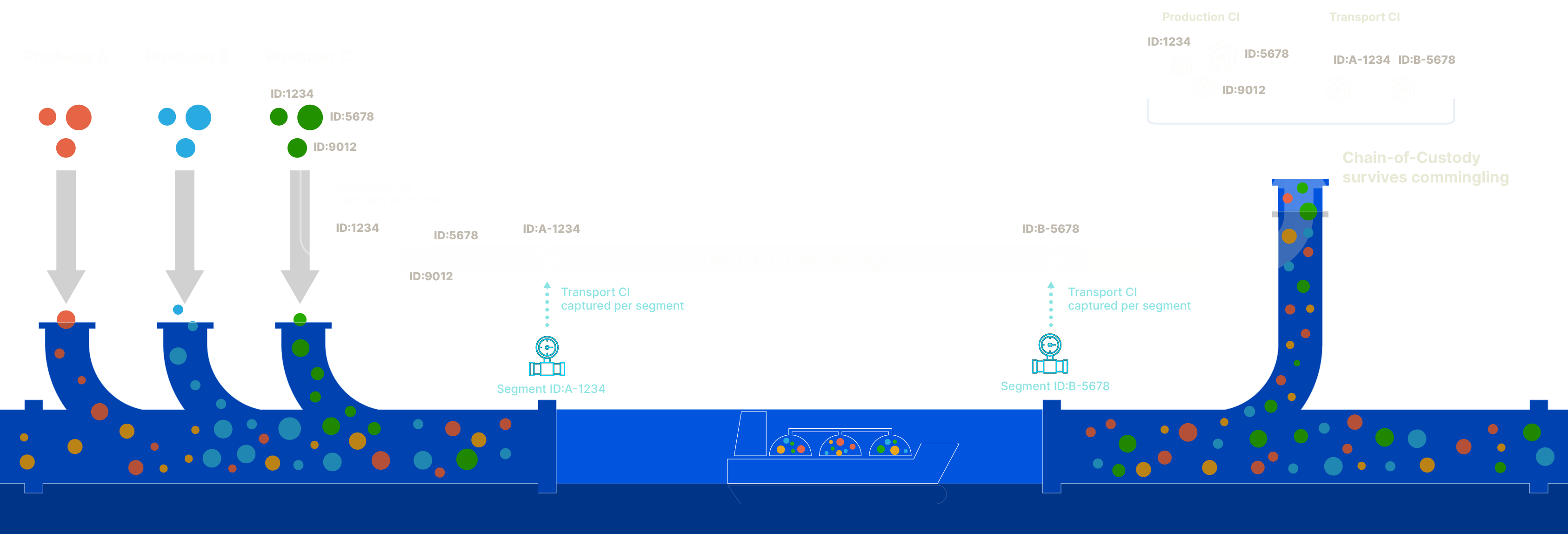
Trace-and-Claim via Mass Balance
Physical Reality
Molecules irreparably commingle in midstream gathering and pipeline networks, breaking legacy tracking.
The EU Mandate
The EU Council specifically requires “trace-and-claim” methodology for complex supply chains to ensure supply security without sacrificing data integrity.
The EarnDLT Mass
Balance Solution
Implements trace-and-claim through mass balance, ensuring attributed outputs never exceed attributed inputs.Maintains temporal and volumetric matching of the QET to physically delivered gas preserving data integrity across commingled systems while capturing full midstream and transporter emissions.
What's Required Under
Regulation (EU) 2024/1787
Article 27 of the EU Methane Regulation
establishes three phased import obligations:
Framework
Operator type
Key Characteristics
OGMP 2.0
Upstream E&P
Gold-standard methane reporting; Level 4–5 measurement preferred
MiQ
Upstream E&P
Certification-based; third-party audited methane intensity scores
OGCI/
One Future
Upstream E&P
Company-level methane intensity target frameworks
NGSI
Upstream/
Midstream
Natural Gas Sustainability Initiative measurement protocols
ISO 14067
Any operator
Product carbon footprint standard; lifecycle-based CI calculation
EPA Subpart W
Upstream/
Midstream
US regulatory GHG reporting; facility-level emissions factors
The token captures which framework(s) were applied for a given cargo, preserving full methodological provenance for EU verification purposes.
From Token to Regulatory Submission

Token Minting
Upstream operator or importer uploads emissions data via EarnDLT's API; pre-issuance validation checks run automatically before any token is minted
Independent Verification
ISO 14065-accredited verifier issues a verification opinion that becomes part of the token's permanent record
Transfer to Importer
token is transferred on-chain to the EU importer's Greentruth registry account
Retirement
importer retires the token against a specific cargo volume and contract reference, generating a blockchain-backed retirement record
Regulatory Export
Greentruth's GasTrace workflow exports the retirement record in a structured format mapped to EU Methane Regulation Article 27 reporting fields
GasTrace discover-acquire-retire-report workflow


Build Your
EU Compliance Stack
The January 2027 MRV equivalence deadline applies to contracts being signed today. Each cargo shipped without an accompanying QET-LNG token is a compliance gap that becomes harder — and more expensive — to close retrospectively.
Book a Compliance Demo
Schedule 30 minutes with the EarnDLT team
Download "Tracking and Transacting Clean Natural Gas"
— Liam O'Byrne & Brad Handler, April 2026
Download the Payne Institute WhitepaperFAQ
Do we need to change our upstream MRV system to generate QET-LNG tokens?
No. QET-LNG is designed to accept data from any recognized North American MRV framework. Your upstream operators continue reporting under their existing methodology; EarnDLT's schema captures the methodology as provenance metadata and normalizes the output into an ISO-aligned, EU-compliant token
What constitutes a "covered contract" under the EU Methane Regulation?
Any supply contract for natural gas placed on the EU market that was concluded or renewed on or after 4 August 2024. This includes contracts currently under negotiation.
Who verifies QET-LNG tokens?
Verification is performed by independent, ISO 14065-accredited third-party verification bodies. The verification opinion is encoded permanently in the token's on-chain record.
What happens if EU enforcement is delayed due to energy security concerns?
The European Commission has stated that penalties cannot be applied in ways that threaten energy supply security. However, the documentation obligation itself remains in force; importers are still required to demonstrate equivalence. Early documentation is the lowest-risk position regardless of enforcement timeline.


